cowboy leather belt | Updated September 2026 | 9 min read | Ya Qalbi Editorial Team
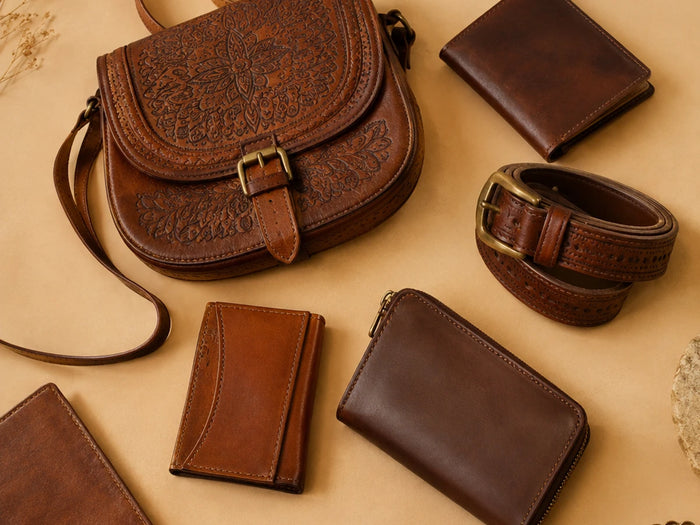
Handmade Cowboy Leather Belts from India: Hand-Tooled Western Style by Ya Qalbi are artisanal full-grain leather accessories crafted by master leatherworkers in Jaipur, Rajasthan. These belts combine traditional Indian hand-carving techniques, including floral scrollwork, turquoise inlays, and hand-painted motifs, with iconic American Western silhouettes and statement buckles. Designed as heirloom-grade pieces, a cowboy leather belt from India offers fashion-forward professionals and travelers a durable, authentic alternative to mass-produced accessories while preserving centuries of Rajasthani craft provenance.
A belt that is stamped, carved, and burnished by hand carries the fingerprint of its maker; that is the difference between an accessory and an heirloom.
Why Handmade Cowboy Belts from India Are Worth a Look
India stands as a premier global hub for authentic Western leathercraft, rooted in centuries of heritage concentrated in Rajasthan's carving ateliers. India's leather sector employs 4.42 million people, with 30% of that workforce being women, supporting specialized artisan production that rivals traditional Western workshops in both structural durability and artistic complexity.
- Centuries of carving tradition: Jaipur leather artisans trace their techniques to 1734, when Maharaja Sawai Jai Singh II made the city a tax haven for artisans, drawing elite craftspeople nationwide.
- A growing export category: Saddlery, harness, and leather accessory exports from India grew by 7.30% year-on-year to $220.38 million, signaling expanding international demand for Indian leather goods.
- Direct artisan value: Indian ateliers provide intricate hand-carving without the inflated retail markups common to legacy Western fashion houses.
- Decade-long durability: Full-grain leather is the highest-grade hide layer, developing a rich natural patina over time rather than cracking like synthetic or bonded leather.
Key Takeaway: India's belt-making tradition combines centuries-old carving skill with an expanding export sector, making a hand-tooled cowboy leather belt from India both culturally authentic and commercially credible. Understanding how these belts are actually made reveals why they outperform factory-stamped alternatives.
How a Hand-Tooled Leather Belt Is Made
A hand-tooled leather belt is a custom accessory crafted through sequential manual carving, stamping, and finishing stages without automated machine embossing. Understanding this labor-intensive process clarifies why an authentic cowboy leather belt provides superior structural integrity and aesthetic depth compared to stamped factory alternatives.
Selecting and Preparing the Hide
Full-grain leather is the outermost, unblemished layer of animal hide, selected for its dense fiber strength and ability to retain deep tooling marks. Artisans cut the hide into precise straps and perform "casing," a process where leather is dampened with water to soften its fibers for deep carving. This preparation step separates hand-tooled work from surface printing, which requires no fiber conditioning.
Carving, Stamping, and Painting
- Swivel-knife carving: A specialized hand-guided blade cuts precision outlines of floral and geometric motifs directly into the dampened leather surface.
- Mallet and stamp work: Metal impression stamps are struck manually with wooden mallets to create dimensional shading, background beveling, and tactile depth.
- Hand-painting details: Natural, leather-safe dyes are brushed by hand into carved sections to color floral petals, vines, and background accents.
- Inlay setting: Natural turquoise stones, polished metal conchos, or hair-on leather panels are embedded into carved recesses for visual contrast.
Key Takeaway: Every stage, from casing the hide to setting the final buckle rivet, is performed by an individual craftsperson, ensuring no two hand-tooled belts are identical. This variability is not a defect; it is the mark of authenticity.
What to Look for in a Quality Cowboy Leather Belt
Identifying an authentic hand-carved leather belt requires evaluating specific material indicators, hardware weight, and structural finishing techniques. Knowing these physical markers ensures you select an authentic heirloom-grade cowboy leather belt rather than a surface-printed mass product.
- Leather type: Authentic full-grain leather feels firm and slightly waxy, displaying unique surface grain variations rather than a uniform, plastic-like coat.
- Carving depth: Genuine hand-tooling produces varied relief depth and crisp carved edges detectable by touch, unlike flat, heat-embossed imitations.
- Edge finishing: Premium belts feature rounded, bevel-cut, and burnished edges sealed smooth to prevent moisture intrusion and fraying.
- Buckle construction: High-grade belts use solid brass, stainless steel, or nickel alloy buckles that provide durable weight and corrosion resistance.
- Stitching and hardware: Look for heavy-gauge saddle stitching along stress points and heavy-duty screw posts or rivets securing the buckle loop.
A belt's buckle can be replaced, but the strap's leather and tooling cannot be faked after the fact; that is where the true value lives.
Key Takeaway: Judge a cowboy leather belt by its leather grain, carving depth, edge finish, and buckle weight to ensure long-term durability and craft authenticity. With these criteria in mind, you are ready to explore the specific styles Ya Qalbi offers.
Our Favorite Ya Qalbi Cowboy Belts
Ya Qalbi's Western collection features five distinct hand-carved belt styles created by Jaipur artisans. Each model highlights artisan craftsmanship, individuality, and practical luxury, ensuring every strap carries distinct hand-finished variations.
| Belt Model | Signature Motif | Standout Detail | Best Style Pairing |
|---|---|---|---|
| Floral Rosette Cowboy Belt | Carved rose rosettes | Deep swivel-knife scrollwork | Classic denim, western boots, casual wear |
| Aztec Tooled Cowboy Belt | Geometric tribal patterns | Bold graphic symmetry | Statement outfits, festival attire |
| Turquoise Inlay Cowboy Belt | Southwestern stonework | Set turquoise and hair-on leather accents | Bohemian and Southwestern ensembles |
| Hand-Painted Rose Belt | Hand-brushed floral color | Multi-tone painted dye detailing | Dresses, tailored cowgirl aesthetics |
| Horse & Horseshoe Cowboy Belt | Ranch heritage icons | Relief-carved horses and horseshoes | Ranch wear, heritage-driven wardrobes |
Key Takeaway: Each Ya Qalbi belt incorporates a dedicated carved motif, allowing wearers to select between classic floral, bold geometric, or iconic ranch heritage aesthetics. Let's explore each option in detail.
Floral Rosette Cowboy Belt - The Classic Western Pick
The Floral Rosette Cowboy Belt is a traditional Western strap decorated with hand-carved rose motifs along the full length of a full-grain leather strap. It offers a classic Western silhouette suitable for both daily wear and formal Western attire.
- Carved rosette pattern: Floral motifs are hand-cut using swivel knives and shaded with beveling stamps for three-dimensional texture.
- Western buckle hardware: Secured with a heavy-duty Western frame buckle that anchors the belt as a functional statement piece.
- Versatile color tones: Finished in hand-rubbed tan and dark oak dyes that complement casual denim and dress trousers.
- Structural resistance: Full-grain strap construction resists leather stretching around belt holes during extended wear.
Key Takeaway: The Floral Rosette belt is the most versatile starting point for wearers seeking a classic Western leather belt for denim and boots. For those drawn to bolder visual impact, the Aztec Tooled option offers an entirely different aesthetic.
Aztec Tooled Cowboy Belt - For Bold, Graphic Style
The Aztec Tooled Cowboy Belt features geometric, tribal-inspired stamp work designed for wearers who prefer sharp graphic contrast over traditional floral carving. Master artisans stamp repeating angular patterns along the entire leather strap with high precision.
- Geometric tooling: Angular tribal patterns are aligned and hand-stamped sequentially to achieve uniform geometric balance.
- High-contrast dye: Hand-applied antique dyes settle into cut grooves, highlighting dark geometric lines against lighter leather tones.
- Statement buckle pairing: Fitted with an engraved Western buckle that complements the bold geometric theme.
- Unisex design: Symmetrical geometric proportions suit both men's and women's Western fashion styles.
Key Takeaway: Choose the Aztec Tooled Cowboy Belt to serve as a high-contrast focal point in modern Western wardrobes. Those seeking color and texture will find their match in the Turquoise Inlay option.
Turquoise Inlay Cowboy Belt - The Southwestern Statement
The Turquoise Inlay Cowboy Belt incorporates Southwestern gem accents and tactile leather panels directly into hand-carved leather grooves. Natural turquoise stones and hair-on hide strips are set by hand to deliver distinctive color and visual texture.
- Hand-set turquoise stones: Genuine turquoise cabochons are embedded into custom leather recesses for secure retention and color impact.
- Hair-on leather accents: Inlaid panels of natural hair-on hide provide rich textural contrast against smooth tooled leather.
- Silver-tone hardware: Finished with antique silver-plated buckles and matching hardware loops to complement blue stonework.
- Artisanal variation: Natural stone shades and hair-on grain patterns make every individual belt unique.
Key Takeaway: This belt functions as wearable jewelry, combining hand-carved leather with genuine turquoise stonework and hair-on hide texture. If you prefer painted color over embedded stone, the Hand-Painted Rose Belt delivers vibrant artistic detail.
Hand-Painted Rose Belt - A Cowgirl Favorite
The Hand-Painted Rose Belt enhances traditional floral carving by adding hand-brushed color pigments directly into carved flower petals and leaves. This technique creates a vibrant, decorative finish tailored for elevated casual wear and dress styling.
- Hand-brushed dye application: Artisans apply leather dyes directly into carved contours using detail brushes to eliminate bleeding.
- Refined color palette: Earthy reds, soft pinks, and botanical greens highlight natural floral motifs without masking hide grain.
- Flattering belt width: Proportioned to fit comfortably through standard dress loops and accentuate high-waisted denim.
- Individual finish: Manual paint application ensures subtle shade variations across every produced belt.
Key Takeaway: The Hand-Painted Rose Belt provides a colorful, artistic option tailored for dresses, skirts, and refined Western outfits. For those drawn to authentic ranch heritage, the final style celebrates equestrian tradition.
Horse & Horseshoe Cowboy Belt - Pure Ranch Heritage
The Horse & Horseshoe Cowboy Belt displays relief-carved equestrian symbols celebrating authentic ranch and rodeo tradition. Deeply sculpted horses and horseshoe figures run continuously along the strap to deliver a clear heritage statement.
- Equestrian iconography: Carved horse profiles and horseshoe motifs represent classic American ranch heritage symbols.
- High-relief carving: Artisans carve deep background channels to make figures stand out in raised, sculptural relief.
- Heavy-duty hardware: Fitted with robust solid alloy buckles designed for active use and outdoor durability.
- Thick hide strap: Cut from extra-dense full-grain leather cuts to preserve stamp clarity under heavy wear.
Key Takeaway: Select the Horse & Horseshoe Cowboy Belt for an authentic, high-relief equestrian piece built for long-term wear. Once you've chosen your style, getting the right fit is essential.
How to Find Your Belt Size
Western belt sizing requires measuring beyond standard trouser sizes because substantial Western buckles add extra length to the overall strap closure. Matching your waist measurement accurately prevents buying straps that fit too short or misalignment with buckle holes.
| Waist Measurement (Inches) | Recommended Belt Size | Target Buckle Hole |
|---|---|---|
| 28-30 in | 32-34 in | 3rd or 4th center hole |
| 32-34 in | 36-38 in | 3rd or 4th center hole |
| 36-38 in | 40-42 in | 3rd or 4th center hole |
| 40-42 in | 44-46 in | 3rd or 4th center hole |
- Measure over pants: Thread a flexible tape measure through your pant loops at the exact height you wear your trousers.
- Account for buckle size: Add 2 inches to your measured waist size to accommodate bulky Western buckle hardware.
- Center hole fitting: Target securing the belt at the center hole (3rd or 4th position) to allow size adjustments in either direction.
- Measure current belts: Measure an existing comfortable belt from the fold where the buckle attaches directly to your used sizing hole.
Key Takeaway: Always size up 2 inches from your standard pant waist size to account for Western buckle hardware dimensions. With the right fit confirmed, styling your new belt across different outfits becomes the next step.
How to Style a Cowboy Belt with Jeans, Dresses and Boots
A hand-tooled cowboy leather belt serves as a functional focal point across casual denim, tailored dresses, and Western boot pairings. Balancing belt width and buckle proportions with garment silhouettes ensures a cohesive appearance.
Styling with Denim
Combine wider 1.5-inch to 1.75-inch straps like the Horse & Horseshoe or Aztec Tooled belts with straight or bootcut denim. Tuck in shirt fronts to expose the carved details and statement buckle as the central visual anchor.
Styling with Dresses
Use narrower, decorative straps like the Hand-Painted Rose Belt to cinch oversized shirt dresses, skirts, or flowing maxi dresses at the natural waist without adding excessive bulk.
Styling with Western Boots
- Harmonize leather tones: Coordinate belt color tones with your boots (such as tan with warm brown) rather than attempting exact shade matches.
- Balance ornate details: Pair highly detailed belts with clean boot designs, or wear plain belts alongside heavily stitched boots.
- Layer with outerwear: Allow visible buckle hardware to show beneath open leather jackets, blazers, or denim coats for structured style.
Key Takeaway: Select wide, deeply tooled belts for denim utility, and choose narrower painted or floral straps to accent dresses. Maintaining your belt properly ensures it looks beautiful for decades to come.
Caring for Your Tooled Leather Belt
Proper leather maintenance preserves full-grain hide flexibility and protects hand-painted dyes and carved grooves from drying out over time. Caring for full-grain leather regularly helps it develop a smooth, attractive patina across decades of use.
- Condition periodically: Apply a natural leather conditioner every 3 to 6 months using a soft cloth to maintain fiber moisture and prevent cracking.
- Wipe off moisture: Remove rain or liquid spills immediately with a dry cloth, letting wet leather air-dry naturally away from artificial heaters.
- Store correctly: Hang belts vertically by the buckle or lay them flat in storage to prevent structural creases in carved zones.
- Clean surface dirt: Brush gently with a soft horsehair brush to clear dust from recessed carving lines without stripping surface dyes.
- Rotate use: Alternate wear between two belts to permit leather fibers to recover structural tension between uses.
Key Takeaway: Regular conditioning, dry storage, and gentle dusting preserve hand-tooled leather detail and flexibility for decades. Ready to bring one of these belts home?
Shop the Ya Qalbi Western Belt Collection
The Ya Qalbi Western belt line offers hand-carved accessories built with full-grain leather hides sourced directly from Jaipur craft workshops. Every belt incorporates distinct carving details, hand-painted artwork, or turquoise settings to provide lasting functional elegance.
- Authentic craft origin: Hand-carved by Jaipur artisans, ensuring every piece reflects individual craft variations as highlighted across Ya Qalbi's design collection.
- Heirloom construction: Full-grain leather builds are engineered to resist fiber tear and age gracefully over years of wear.
- Versatile design selection: Five specialized models provide tailored styling options across classic floral, Southwestern, graphic, and ranch aesthetics.
- Elevated travel utility: Designed to offer statement style for daily urban wear, travel, and Western wardrobe styling.
Key Takeaway: Explore the complete Ya Qalbi collection online to select authentic hand-tooled leather belts crafted by Jaipur master artisans.
Conclusion
A hand-tooled cowboy leather belt from India combines centuries of Rajasthani carving heritage with classic Western silhouettes, delivering lasting durability and craft depth. Ya Qalbi brings this tradition to modern wardrobes through full-grain leather construction and detailed hand-finishing.
- Master craft quality: Authentic hand-swivel carving and full-grain hides outperform surface-stamped, synthetic leather products.
- Legitimate artisan heritage: Jaipur's centuries-old leather workshops offer exceptional carving expertise and global production value.
- Flexible wardrobe application: Proper belt sizing and width selection enable easy styling across denim, dresses, and Western boots.
- Long-term investment: Simple routine conditioning preserves leather flexibility and carved relief detail for decades.
- Curated selection: Ya Qalbi provides five distinct hand-carved styles tailored for every individual aesthetic preference.
Measure your waist with Western buckle allowances, pick your favorite carved motif, and discover the entire selection directly on the official Ya Qalbi website.
FAQ
Handmade Cowboy Leather Belts from India: Hand-Tooled Western Style by Ya Qalbi, what makes them different?
Handmade Cowboy Leather Belts from India: Hand-Tooled Western Style by Ya Qalbi are artisanal accessories cut from full-grain leather and hand-carved by master artisans in Jaipur, Rajasthan. They integrate traditional Indian leathercrafting techniques, including swivel-knife carving, turquoise inlays, and hand-applied dyes, with iconic American Western silhouettes and statement buckles. Because every strap is carved manually rather than machine-embossed, each belt exhibits unique depth, character, and long-term durability that mass-produced accessories cannot replicate.
What makes a cowboy leather belt "hand-tooled"?
Hand-tooling is a manual leatherworking technique where an artisan uses a handheld swivel knife to cut pattern outlines and metal impression stamps with mallets to press depth into dampened leather. This process differs from machine embossing, which uses heated metallic rollers to press shallow, mechanical designs onto leather surfaces without individual hand-carving.
How do I choose the right belt size for a Western buckle?
Measure your waist over your standard clothing with a flexible tape measure, then add 2 inches to your measurement to account for larger Western buckle dimensions. Select a belt size that fastens around the middle hole (the 3rd or 4th hole), allowing equal sizing adjustments larger or smaller over time.
Is full-grain leather better than other leather for cowboy belts?
Full-grain leather is the highest grade of leather hide, retaining dense surface fibers that withstand deep knife cuts and heavy stamping without splitting. It resists stretching around buckle holes and develops a rich patina over time, unlike bonded or genuine leather, which cracks under stress.
Can women wear cowboy leather belts with dresses?
Yes, women can style cowboy belts over dresses by selecting narrower 1-inch to 1.25-inch straps with decorative floral or hand-painted details. Cinching narrower straps at the natural waist accents dress silhouettes without creating structural bulk around the midsection.
How long does a hand-tooled leather belt from India last?
A full-grain hand-tooled leather belt can last 20 years or longer when properly conditioned and stored. High-grade full-grain leather absorbs natural oils, increasing flexibility and structural resistance over decades of continuous use.
How do I care for a hand-tooled leather belt?
Condition your belt with a soft cloth and neutral leather conditioner every few months to keep fibers moist. Wipe away liquid spills immediately, dust grooves with a soft brush, and hang the belt vertically to prevent creasing across carved patterns.
Where can I buy authentic handmade cowboy belts from India?
Authentic handmade cowboy leather belts from India can be purchased directly from specialized artisan brands like Ya Qalbi. Their collection features full-grain leather straps hand-tooled in Jaipur, complete with classic Western hardware and detailed craft finishes.
This article was researched using publicly available industry data from the Council for Leather Exports, government trade publications, and documented accounts of Jaipur leatherworking history. Product details reflect Ya Qalbi's stated design and materials; no customer reviews, ratings, or testimonials have been invented or implied.