Western tooled leather belt price guide - what affects cost | Updated September 2026 | 9 min read | Ya Qalbi Editorial Team
A Western tooled leather belt is a handcrafted accessory featuring hand-carved, stamped, or embossed motifs on durable hide. Based on our Western tooled leather belt price guide - what affects cost analysis, overall belt pricing is determined by five primary variables: leather grade, hand-tooling complexity, hardware quality, construction technique, and brand craftsmanship standards. In India, an authentic tooled belt made from full-grain or vegetable-tanned leather typically ranges from ₹2,500 to ₹18,000 depending on materials and artisan labor, while mass-market synthetic look-alikes sell for under ₹1,000 but rarely last more than a season.
Most shoppers researching a Western tooled leather belt price guide - what affects cost run into the same problem: retailers quote a final number with almost no explanation of the underlying craftsmanship, tanning process, or hardware sourcing behind it. Even well-regarded Western leather houses list belts anywhere between roughly $145 and $440 without publishing a clear breakdown of what separates the entry tier from the top tier. This guide cuts through that opacity, providing transparent pricing logic so buyers can distinguish between a fair investment and an inflated retail price.
A belt is one of the few accessories worn daily for a decade or more, which means its price per wear often ends up lower than a pair of shoes replaced every eighteen months, provided the leather and tooling were genuine to begin with.
What Determines a Western Tooled Leather Belt's Price?
The price of a Western tooled leather belt is set by raw material grade, hand-tooling depth, buckle quality, and workshop reputation. These four core drivers typically account for 80 to 90 percent of the final retail price, with brand positioning and retail markup filling the remainder. Understanding this breakdown forms the foundation of any credible Western tooled leather belt price guide - what affects cost evaluation.
The Core Cost Drivers
- Leather grade: Full-grain and vegetable-tanned hides cost significantly more per square foot than corrected-grain or bonded leather, aging into a richer patina over years of wear.
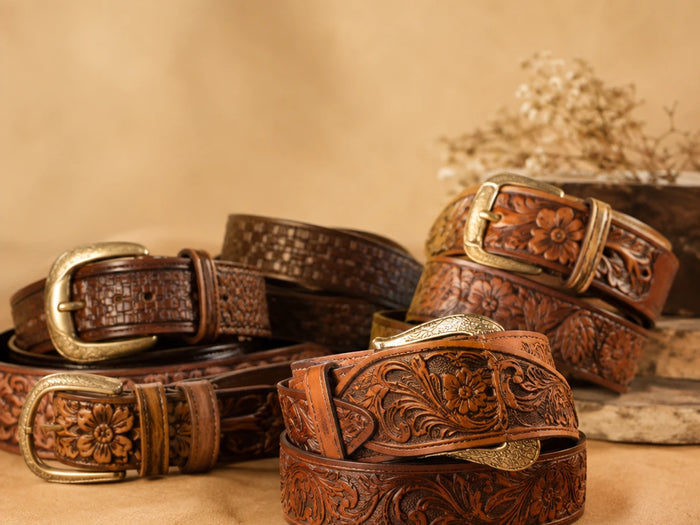
- Tooling complexity: Hand-carved floral, basketweave, or Sheridan-style patterns require hours of skilled labor per belt, unlike machine-embossed designs that take minutes.
- Hardware quality: Solid brass or nickel-plated buckles with detailed engraving cost more than stamped alloy buckles and resist corrosion far longer.
- Construction method: Hand-stitched edges, burnished finishing, and reinforced billet ends add labor time that machine-stitched belts skip entirely.
- Workshop reputation: Established ateliers with documented craftsmanship command a premium because buyers pay for consistency and strict quality control.
Price Band and Quality Breakdown
| Price Band (INR) | Typical Leather | Tooling Style | Expected Lifespan |
|---|---|---|---|
| Under ₹1,000 | PU or bonded leather | Machine-embossed print | 6-12 months |
| ₹1,000-₹3,500 | Corrected-grain leather | Light embossing | 1-3 years |
| ₹3,500-₹8,000 | Top-grain or split leather | Semi-hand tooled accents | 3-6 years |
| ₹8,000-₹18,000+ | Full-grain, vegetable-tanned | Fully hand-carved motifs | 10+ years with care |
Key Takeaway: No single factor sets a belt's price on its own; it is the interaction between hide quality, hand-tooling depth, and hardware that determines whether a belt sits in the disposable tier or the heirloom tier. The leather itself sets the ceiling for everything else that follows.
How Does Leather Quality and Sourcing Affect Belt Cost?
Leather grade and sourcing origin account for nearly half of the raw material cost in a Western tooled belt, as full-grain and vegetable-tanned hides are priced per square foot based on tannery grade and finishing process. Vegetable-tanned leather is hide processed using natural plant tannins rather than synthetic chemicals, making it ideal for tooling because it retains deep carved impressions. India's leather hub in Kanpur remains a major global sourcing center, where raw hide pricing directly impacts domestic and export retail costs.
Understanding Leather Grades
- Full-grain leather: The highest-quality hide tier utilizing the entire top layer including natural grain, making it the strongest and most tooling-friendly option available.
- Top-grain leather: Leather lightly sanded to remove surface imperfections, offering a smoother finish at a moderate price point with slightly reduced longevity.
- Vegetable-tanned leather: Hide tanned using natural plant tannins, highly prized for tooling because it holds carved detail crisply and develops a warm patina.
- Corrected-grain and bonded leather: Reconstituted or heavily processed leather scraps that cost a fraction of full-grain but crack and delaminate quickly.
Raw Material Cost Dynamics
Wholesale market data from Kanpur shows vegetable-tanned buffalo and goat leather trading between roughly ₹60 and ₹200 per square foot depending on thickness, finish, and grade. A single belt consumes 1.5 to 2.5 square feet of leather after wastage and pattern-cutting, making raw hide cost alone account for ₹150 to over ₹500 before labor or hardware are added.
India's annual leather availability exceeds 2.5 billion square feet, yet only a small fraction meets the full-grain, vegetable-tanned standard that hand-tooling demands.
Key Takeaway: When a belt's retail price is disproportionately low, the maker has likely substituted corrected-grain or bonded leather for genuine full-grain stock. The raw material choice is where quality either begins or falls short.
What Does Hand-Tooling Craftsmanship Add to the Price?
Hand-tooling is the single most labor-intensive cost component of a Western belt, as every swivel-knife cut, background stamp, and dye accent is applied individually by hand. A deeply carved Sheridan-style floral belt takes a master artisan four to twelve hours to complete, compared to under thirty minutes for a machine-embossed equivalent. That time difference is everything.
Machine-Embossed vs. Hand-Tooled Comparison
| Attribute | Machine-Embossed | Hand-Tooled |
|---|---|---|
| Production time per belt | 15-30 minutes | 4-12 hours |
| Pattern depth | Shallow, uniform | Deep, individually varied |
| Skill level required | Machine operator | Trained leather artisan |
| Typical price premium | Baseline | 2x to 5x baseline |
Why the Labor Premium Is Justified
- Swivel-knife carving: Each line of the design is cut by hand into damp leather, ensuring no two hand-tooled belts are perfectly identical.
- Background stamping: Artisans press dozens of distinct stamping tools into the leather to create depth and texture around primary motifs.
- Hand-dyeing and antiquing: Dye is applied manually into carved recesses to highlight three-dimensional contrast that spray dyeing cannot match.
- Skill scarcity: Master tooling artisans undergo years of apprenticeship, and their limited numbers keep authentic hand-tooled leather goods in a luxury tier.
Key Takeaway: The price gap between a ₹2,000 embossed belt and a ₹10,000 hand-tooled belt reflects roughly ten times the skilled labor hours invested in the piece. Hardware and finishing details represent the next opportunity to spot the difference between genuine craft and mass production.
How Do Hardware and Finishing Details Influence Belt Pricing?
Hardware, edge finishing, and stitching techniques contribute 15 to 30 percent of a Western tooled belt's final cost. These details represent the fastest way to verify whether a belt is genuinely handcrafted or mass-produced, as hardware and stress points are typically the first components to fail under daily wear.
Hardware and Construction Checklist
- Buckle metal: Solid brass, sterling silver overlay, or nickel-plated zinc alloy buckles resist corrosion and snapping far better than cheap pot-metal alternatives.
- Stitching type: Hand-saddle stitching using waxed thread creates independent stitches that will not unravel if a single thread breaks, unlike machine lockstitching.
- Edge burnishing: Beveled and burnished edges sealed with natural wax or gum prevent fraying and indicate meticulous finishing work.
- Billet reinforcement: Double-stitching or riveting at the buckle attachment point reinforces the highest stress zone to prevent tear-out over time.
- Keeper loop construction: A custom keeper loop tooled to match the main belt pattern demonstrates full design integration rather than off-the-shelf assembly.
At Ya Qalbi, every leather accessory is constructed using solid hardware, natural tanning methods, and detailed finishing to ensure long-term durability. By treating craftsmanship as the foundation of everyday luxury, products are engineered to deliver lasting value rather than seasonal replacement.
Key Takeaway: Always inspect buckle attachment points and edge burnishing before purchasing, as these details reveal true construction quality better than surface patterns alone. Understanding what a fair price looks like in today's market helps you spot both value and inflation.
What Is a Fair Western Tooled Leather Belt Price in India for 2026?
A fair price for a hand-tooled leather belt in India in 2026 depends on the precise combination of hide grade, tooling depth, and metal hardware chosen. Consulting a transparent Western tooled leather belt price guide - what affects cost helps buyers evaluate market standards accurately. India's leather goods market reached USD 13.4 billion in 2024 and is projected to reach USD 20.1 billion by 2033, driven by growing consumer demand for handcrafted, premium leather items.
Tax and Regulatory Context
Every genuine leather belt sold commercially in India is subject to an 18% GST rate under HSN code 42033000. This tax has applied to finished leather belts and bandoliers since November 2017 and is included in final retail prices across all tier levels.
What Fashion-Forward Buyers Should Expect to Pay
- Entry luxury tier (₹3,500 to ₹6,000): Top-grain leather featuring partial hand-tooling and an alloy buckle, built for daily casual and travel wear.
- Statement tier (₹6,000 to ₹12,000): Full-grain, vegetable-tanned leather with deep hand-carved floral patterns, solid brass hardware, and hand-burnished edges.
- Heirloom tier (₹12,000 and above): Custom or limited-run belts with multi-motif tooling, premium buckle finishes, and documented artisan provenance.
- Red flags to avoid: Items priced under ₹1,500 claiming to be full-grain and hand-tooled almost exclusively utilize bonded leather and machine embossing.
For professionals seeking refined craftsmanship, Ya Qalbi's curated leather accessories collection offers pieces designed around transparent pricing, pure materials, and timeless Western design principles.
Key Takeaway: A fair 2026 price in India reflects the 18% GST baseline plus specific premiums for leather grade, tooling depth, and hardware quality. When you know these factors, you can walk into any shop with confidence.
Conclusion
A comprehensive Western tooled leather belt price guide - what affects cost reveals that pricing rests on five measurable factors: hide quality, labor hours, hardware strength, edge construction, and maker reputation. Buyers who evaluate these core metrics can make informed purchasing decisions with complete confidence.
- Leather grade matters most: Full-grain vegetable-tanned hides provide a superior structural base that lasts over ten years and develops a rich patina.
- Hand-tooling reflects labor: Deep hand-carving requires up to twelve hours of skilled work per belt, justifying higher craftsmanship costs.
- Hardware confirms quality: Solid brass buckles, saddle stitching, and burnished edges differentiate genuine artisan work from mass assembly.
- GST adds a fixed baseline: The standard 18% GST rate applies to all legitimate leather belts in India under HSN code 42033000.
- Transparency ensures value: Reputable brands explain their material sources and labor processes clearly to validate retail price points.
Style-conscious buyers looking for authentic leather craft can explore Ya Qalbi's collection of handcrafted leather bags and accessories, where every piece combines natural hides, solid hardware, and honest pricing.
FAQ
Western Tooled Leather Belt Price Guide 2026: What Affects Cost?
The price of a Western tooled leather belt in 2026 is determined by five primary variables: leather hide grade, hand-tooling complexity, buckle hardware quality, construction method, and artisan workshop standards. Full-grain, vegetable-tanned leather combined with deep hand-carved motifs commands higher prices due to material costs and intensive labor. In India, fair market prices range from ₹3,500 for entry luxury hand-tooled belts to over ₹18,000 for heirloom-grade pieces, which includes the mandatory 18% GST applied under HSN code 42033000.
Why do some tooled leather belts cost so much more than others?
The price variation stems directly from material quality and labor time. A hand-carved belt requires four to twelve hours of skilled artisan work compared to under thirty minutes for a machine-embossed belt, while full-grain vegetable-tanned hide costs significantly more per square foot than bonded or synthetic alternatives.
Is full-grain leather worth the extra cost for a tooled belt?
Yes, full-grain leather is worth the higher initial investment because it retains carved tooling details crisply, resists surface cracking, and develops a desirable patina over years of daily wear, whereas bonded leather degrades within one to three years.
How can I tell if a belt is genuinely hand-tooled versus machine-embossed?
Genuine hand-tooling exhibits slight variations in stroke depth, bevel angles, and dye density within carved grooves upon close inspection. Machine-embossed belts display identical, shallow surface patterns across every unit produced without true dimensional depth.
What is a reasonable price range for a hand-tooled leather belt in India?
A fair price in India ranges from ₹3,500 to ₹6,000 for entry luxury top-grain belts with partial hand-tooling, ₹6,000 to ₹12,000 for full-grain hand-carved statement belts, and ₹12,000 or more for custom heirloom pieces with premium solid hardware.
Does GST affect the final price of a leather belt in India?
Yes, all finished leather belts sold legally in India fall under HSN code 42033000 and carry a standard 18% GST rate, which is calculated as part of the total retail cost shown to consumers.
What hardware details should I check before paying a premium price?
Inspect the buckle to ensure it is solid brass or nickel-plated metal rather than hollow alloy, verify that edge stitching uses two-thread saddle stitching rather than single machine lockstitching, and check that belt edges are smoothly burnished and sealed.
How long should a genuine tooled leather belt last?
A well-maintained full-grain, hand-tooled leather belt paired with solid hardware will easily last ten years or longer under daily wear, whereas corrected-grain or synthetic options usually break down within 6 to 36 months.
This guide was compiled using publicly available India leather industry pricing data, GST classification records, and market research reports current as of September 2026; prices and tax rates are subject to change and buyers should verify current rates before purchase.